Replacing the spark plug of a Palazzetti Lara pellet stove
After years without replacement, the igniter on a Palazzetti Ecofire Lara stopped firing. This post covers the fault diagnosis without opening the stove, the correct replacement part, and the replacement procedure.
The igniter had been running for seven years without a replacement. When it stopped firing mid-winter, the fastest fix was to do it myself.
After occasional startup failures over a few months, the pellet stove stopped lighting entirely. A quick paper test confirmed the igniter was dead without needing to open the stove. This post covers the diagnosis, choosing the right replacement part (flange type is the critical dimension), and the replacement procedure.
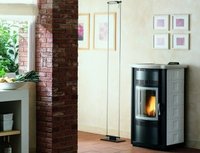
Symptoms and diagnosis
Over a few months the stove developed occasional startup failures despite its annual cleaning. Eventually it stopped lighting at all — the auger fed pellets normally, the combustion fan ran, but no ignition.
Everything pointed to the igniter (also called the spark plug or glow plug): the intake fan was working (confirmed by holding a sheet of paper against the intake pipe — it was drawn in strongly), and the auger was delivering pellets, so the fault was in the ignition path.
Confirming the igniter is dead without opening the stove: start a normal ignition cycle, wait the full 5 minutes it would normally take to light, then — while still in the ignition phase — open the door, temporarily block the pellet inlet, remove the pellet tray, and slip a small piece of paper into the igniter compartment. No heat marks on the paper confirms the igniter is not firing.
Igniters typically last around 3 years under normal use. Mine had never been replaced in 7 years, so this was overdue.
Opening the stove and confirming with a multimeter
The stove can be opened in place:
- Cut power at the wall.
- Remove the top panel, side panels, and rear grille.
- The igniter is threaded into the air intake tube and secured with one screw accessible from the right side.
- Trace the igniter cable to the control board in the lower right of the stove. You will need to cut a few cable ties and unscrew the control box cover to free enough cable length.
The igniter is a resistive element — polarity does not matter. Measuring across the terminals with a multimeter in continuity mode should show a low resistance (typically 100–200 Ω on a healthy element). Mine showed no continuity at all, confirming it was open-circuit.
Choosing the correct replacement
The Palazzetti Ecofire Lara takes a standard pellet stove igniter with these specifications:
| Parameter | Value |
|---|---|
| Power | 350 W |
| Total length | 170 mm |
| Length under flange | 160 mm |
| Resistance (new) | ~138–150 Ω |
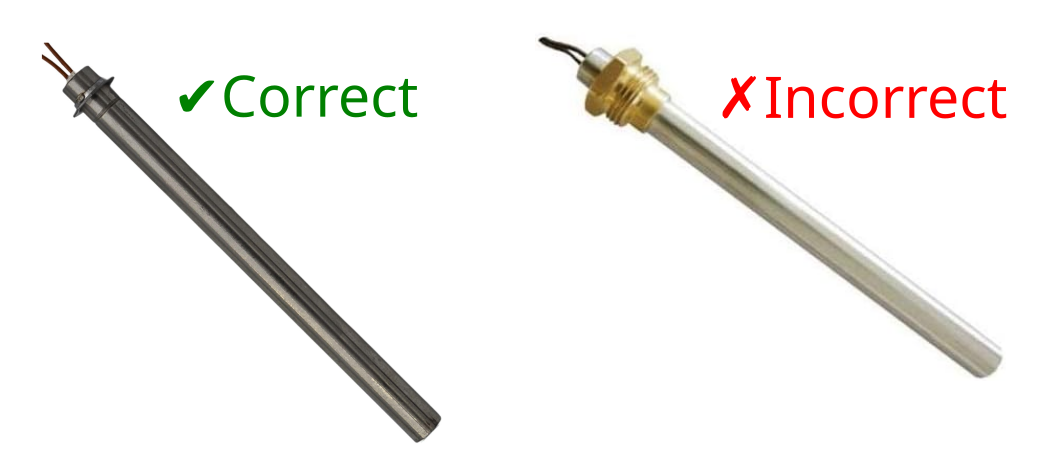
The flange type is the dimension that catches people out. There are two common flanges: a flat steel flange (correct for Palazzetti) and a hexagonal brass fitting (designed for threaded installation in other brands). They are not interchangeable.
Amazon offers these at roughly half to one-third the price of specialist heating parts suppliers, and the part is a commodity resistive element with no proprietary electronics. The model I chose1 was available for next-day delivery — not a small consideration mid-winter.
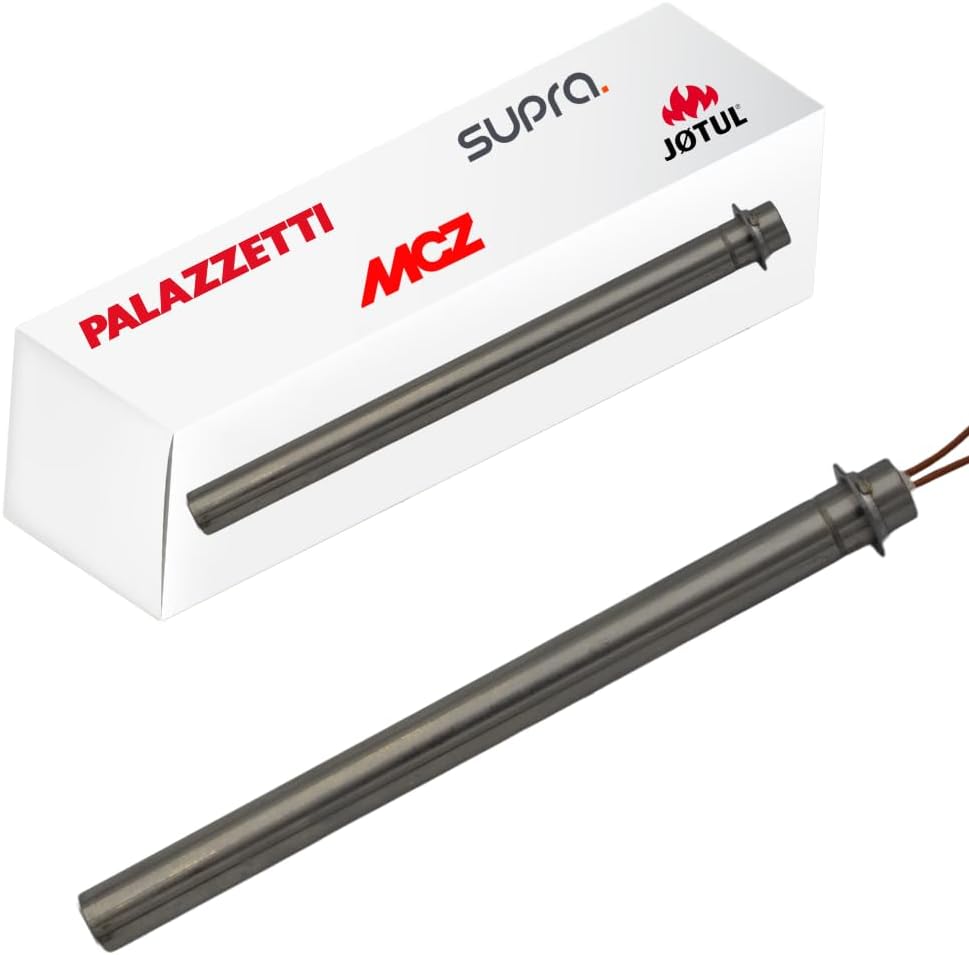
Verification before installation: the new element measured 150 Ω.
$$R_\text{expected} = \frac{U^2}{P} = \frac{230^2}{350} \approx 151\ \Omega \quad \checkmark$$
$$P_\text{actual} = \frac{U^2}{R} = \frac{230^2}{150} \approx 353\ \text{W} \quad \checkmark$$
Close enough to spec. The stove does not need a precision element here — any value within ~10% of nominal is fine.
Replacement procedure
- Cut the old cable ties holding the igniter cable along its routing path. Note the original path before cutting — the cable makes a wide loop right then left to reach the control board.
- Unscrew the single retaining screw on the right side of the igniter housing.
- Pull the igniter out of the intake tube.
- Slide the ceramic insulating sleeve from the old cable onto the new igniter cable, trimming it to length if needed.
- Route the new cable along a more direct path to the control board (the replacement cable was slightly shorter than the original; a straighter route solved this).
- Connect to the control board terminal — either orientation is correct.
- Secure the cable with new cable ties.
- Insert the igniter into the intake tube and tighten the retaining screw.
- Reassemble the panels.
On the next startup the stove lit within 3–4 minutes, back to its normal ignition time.
The repair took about half an hour and cost under €25. The paper test in the diagnosis section is a small trick I came across online — it lets you confirm a dead igniter before opening anything, which is worth knowing when you’re trying to identify the fault without disassembly.
-
Pellet stove igniter 350W 170mm — purchased February 2024 for €19.99. A cheaper alternative was available (B01MRJ01FN at ~€16) but was not tested. ↩